
Envisioning A World Without Prisons
Centering the lived experiences of the incarcerated and the criminalized as expertise

Dear kapwa1,
In my last newsletter, I shared that I’ve been working in the federal prison system to facilitate writing workshops and storytelling circles with incarcerated men from Black, Indigenous, and racialized communities. Through my arts organization, Living Hyphen, we’ve been exploring our heritage, our ideas of home(s), and the power of our stories and voice.
Before I started this project, my dear friend Shruthi – whom I first met through another Living Hyphen workshop a year prior – brought me to the book launch for Justin Piché and Rachel Herzing‘s ‘How to Abolish Prisons’ in Vancouver’s Downtown East Side. The panel included formerly incarcerated people and activists for prisoner rights who all shared their perspectives and contributions to prison abolition – that is, the “political vision with the goal of eliminating imprisonment, policing, and surveillance”2 and “[build] life-affirming and life-enabling communities in their place.”3
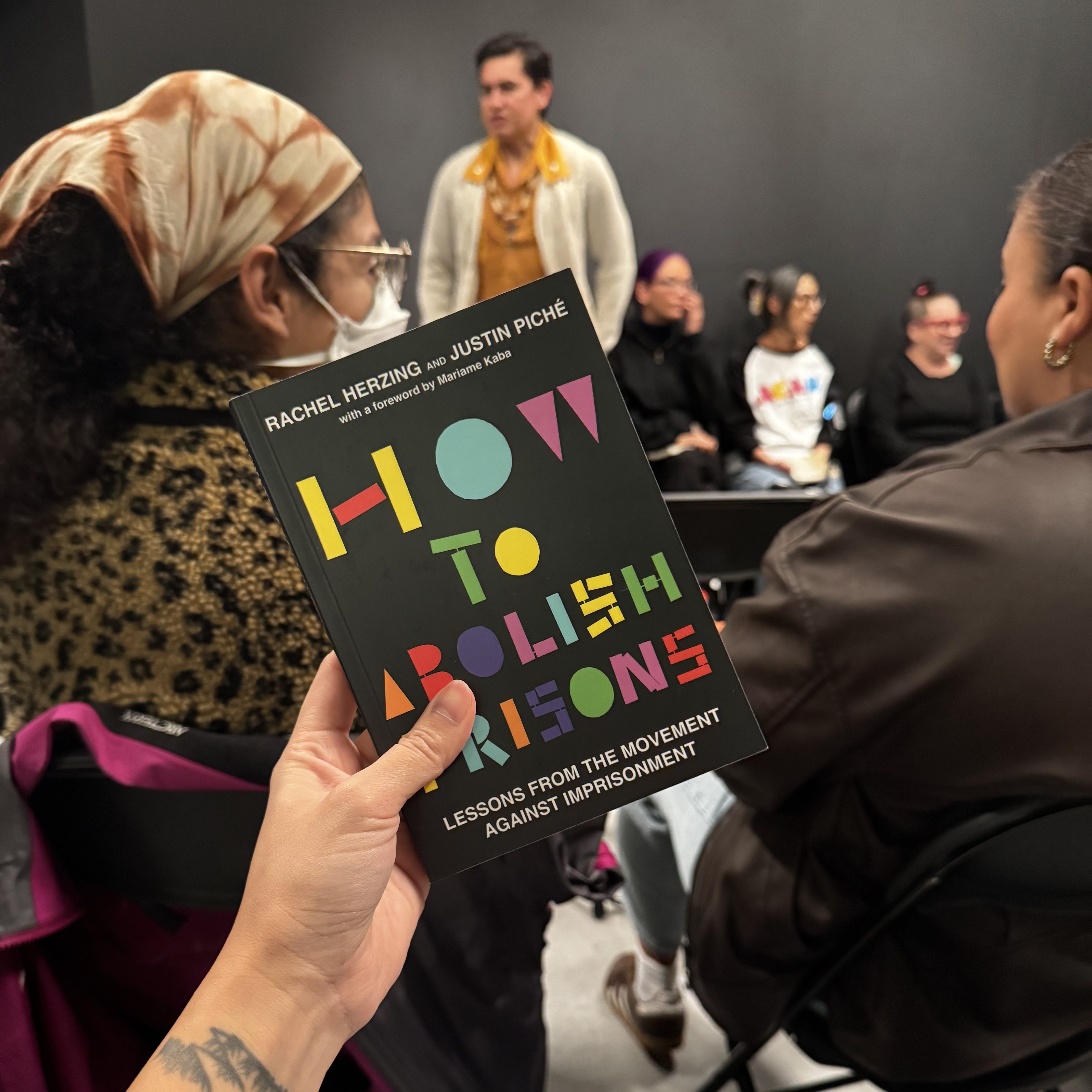
What Would A World Without Prisons Look Like?
If you asked me this question ten years ago, I would have likely looked at you confused and completely dumbfounded. What a preposterous idea. How could our society possibly function without prisons? We need prisons to protect our communities from “the bad guys”...to keep our communities safe. We need prisons to serve justice when people break the law and commit heinous crimes that harm those around us.
But then I look at the world around us, and it really makes me question these premises. I look at the people in power who have gotten away with war crimes and genocide and running global sex trafficking rings and destroying our climate and exploiting people for endless profit, and I have to ask myself – who really are the bad guys? Who really keeps our communities safe? Who is really brought to justice for their crimes? And are the systems that we’ve built really what justice looks like?
The movements of the last decade – Idle No More, Black Lives Matter, #MeToo, Standing Rock, Occupy Wall Street, Mauna Kea, the Climate Strike, among many, many others – have taught me to think deeply and critically about the differences and distinctions between punishment and accountability, between control and justice. Most importantly, these movements have taught me to imagine a world far more expansive, just, and liberated than what we’ve been made to believe is possible.
My time inside working, writing, and sharing stories with incarcerated men has only revealed with even more clarity just how delusional our ideas of “safety” really are. These men teach me so much about power and oppression, about the cycles of harm and violence that our systems deliberately refuse to break. I see firsthand how isolation is not accountability, how captivity is not justice.
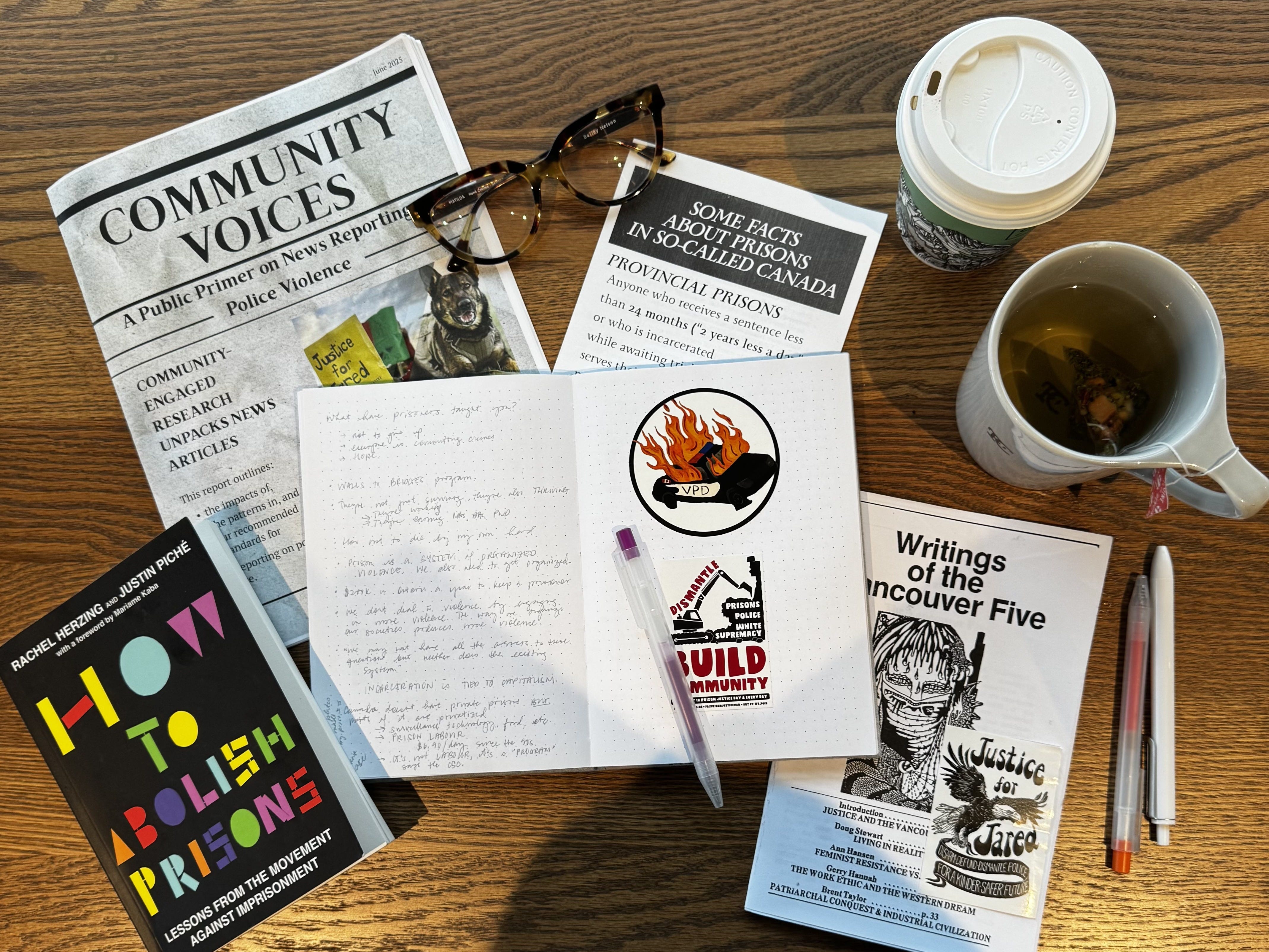
Bridging Colonial Histories with Present-Day Injustices
My storytelling circles would begin the same way as any other Living Hyphen gathering: by positioning our work and our storytelling as a political act.
We’re here on the traditional and unceded territory of the Semá:th First Nation and Máthxwi First Nation. Many of us here are settlers – regardless of when we or our parents or grandparents, or however far back our ancestors arrived – who have benefitted and continue to benefit from colonial violence on this land. Colonization is not just something that happened in the past, but an ongoing process that continues this very day to inflict violence on Indigenous lands, cultures, and bodies.
In addition to being on stolen land, what is now known as Canada and the US was built by Black people who were themselves stolen from their own homelands and who continue to be oppressed under this white supremacist system.
Many of us who are from racialized communities come from places around the world whose histories are similarly bound up in colonization, imperialism, military occupations, and racist immigration policies.
My own history as a Filipina speaks to this reality. The Philippines was colonized for 333 years by the Spaniards, only to be sold to the United States in 1946. We were then under American colonial rule for another 48 years, and remain under their heavy influence despite our independence.
As we share stories of our home, heritage, and cultures, it’s important to remember just how interconnected all of our histories and continued struggles really are…
Sharing these words always feels especially potent and urgently necessary after going through such heavy security required when entering any prison.
And my words were met with such fierce recognition and understanding; it would open the floodgates to deeper conversations about race, power, and oppression, and the men would school me in their long, complicated, and nuanced histories.
Ajani gave us all a history lesson on Jamaica’s colonial history – how the indigenous Taíno peoples came under Spanish rule for 160+ years before England conquered the island, making his homeland an important part of the British West Indies.
Kiran proudly shared his Punjabi roots and the intense violence that was brutally inflicted on his people as a result of Britain’s callous and truly thoughtless Partition of India in 1947.
Yao spoke at length about the pan-African movement led by Kwame Nkrumah, the first president of his homeland, Ghana, and how that sparked independence movements all across the continent in the 1960s.
Chris reflected on the experiences of his Indigenous ancestors and how his parents were a part of the Sixties Scoop, the wide-scale forced removal of Indigenous children from their homes, communities, and families of birth and placed in foster care or adopted out to non-Indigenous families.
We talked about the myriad of injustices that come from colonization and how that trauma is passed down across generations and impacts our everyday lives in so many ways, seen and unseen. We talked about how much of this inherited trauma has led to the choices they’ve made and their present-day realities in the prison system; how the criminal “justice” and prison systems are themselves born out of colonization.
These discussions would often take longer than our actual writing prompts, but that didn’t matter. In fact, that was the point – to spark a conversation about our complex roots and our heritage. To recognize our histories and understand how it all connects to our present-day circumstances. To find ways to bridge these gaps and begin to create pathways to healing.
Over the years, I’ve been asked to design and deliver anti-racism and anti-oppression trainings for businesses, school boards, and other organizations. So much of these discussions remains on the intellectual, sometimes abstract level. But these guys? They know it in their bones. They don’t need any kind of “training”.
The men inside understood instantly when I talked about colonization and racism and oppression. It is inherent for them. It is lived knowledge. It is in their very bodies.
And the intimate stories they shared throughout these writing circles revealed their expertise on the realities of the world we all live in, the realities that tangibly, physically, and materially impact the way we all move through the world. This was not merely an intellectual exercise.
At the end of our time together, I would be led out of the prison maze with every turn guarded by lock and key. After going through the body scanner, collecting my phone, and being let through one final gate, I would get into my rental car and just sit in the parking lot to take in the day. I looked out at the majestic peaks of the Cheam Range with barbed wire cutting across the foreground, thinking about all the stories these men had shared with me, all the stories that I have the deep privilege of holding.
I wonder what it would be like if our society took the time to learn from these men and the communities that they come from? What would our world look like if we centred lived experience as expertise and actually took the time to listen to those most deeply impacted by systems of oppression? What would it look like to honestly and critically look at harm and how we might heal, not punish, it? How differently might we choose to design our world? How might our horizon of possibilities expand and deepen?
These are the questions that fill my days. I hope to continue sharing what I learn along the way…
In loving solidarity,
Justine
What’s Happening In My World:
If you’re new to these ideas of prison abolition and have no idea what I could possibly be talking about, I get it! Believe me, I do. It has taken me years of (un)learning, and I am still very much on that journey and being challenged every day. Check out my latest book column on 49th Shelf focused on books on abolition.
Living Hyphen’s summer programs are here and we are excited to offer a variety of playshops that focus on creative writing, clay-making, doodling, and zine-making. Together, we’re unpacking the chaos and contradictions of this moment while still making space for joy, tenderness, and possibility. In a society that feeds off our disconnection and despair, we are choosing creativity, curiosity, and shared imagination. Will you join us? Learn more and register here.
Earlier this month, I took part in 24 Hours of Palestinian poetry to mark the Nakba, the mass displacement and dispossession of Palestinians in 1948. It was a poignant gathering honouring 78 years of Palestinian resistance against Israeli genocide, siege, dispossesion, and displacement. Watch this reading of Fargo Tbakhi's brilliant poem 'Palestine Is a Futurism: Prophecies (Cruising Jerusalem)'.
I don’t often do Asian Heritage Month presentations anymore, but I made an exception this year and was it ever a delight! I can’t express the joy I felt when I shared my story in a gym full of young students who were so excited to talk to me about their own lived experiences, who asked me thoughtful questions about my migration story, and who stayed behind during their recess to tell me how much my story made them “feel seen.” Here’s a snapshot of these cuties!
I’m taking part in Fierce Vulnerability: Kinship Lab, a global 3-month program to inspire collective action rooted in healing, emergence, and deep care. Led by author and nonviolence practitioner Kazu Haga, I’ll be connecting with Tkaronto-based healers to co-create community-inspired action projects that embody the spirit of fierce vulnerability.
Support My Work:
If you enjoy reading this newsletter and find the work I do valuable, you can support my work by supporting Living Hyphen, the community I steward to explore the experiences of those living in between cultures. You can do that through a number of ways:
Hire us! Share our work with your school, company, or other spheres of influence. Over the last few years, we’ve had the honour of working with various partners to deliver our storytelling workshops to different communities across the country. We believe that our stories carry the power to heal ourselves, our relationships, and the world.
Support racialized writers in financial need with a one-time contribution. Your contribution will go to our scholarship fund to offset the cost of a ticket to our writing workshops.
Make a monthly contribution on Patreon to support our ongoing programming.
Support storytellers from 60+ ethnic backgrounds, religions, and Indigenous nations from all across Turtle Island by reading our magazines or listening to our podcast!
Follow Living Hyphen on Instagram and engage with us on social media.
Kapwa is a concept in Filipino culture that recognizes our shared identity, our interconnectedness, our common humanity.
What is the prison industrial complex? What is abolition? Definitions by Critical Resistance.
Quote from Ruth Wilson Gilmore.
Justine, I'm glad that you are sharing your interaction with the prison system as a means to explore more radical visions. Thank you for accompanying me to the book launch event. So happy to see pictures from that day.
Hope to see you back in this neck of the woods, soon! <3